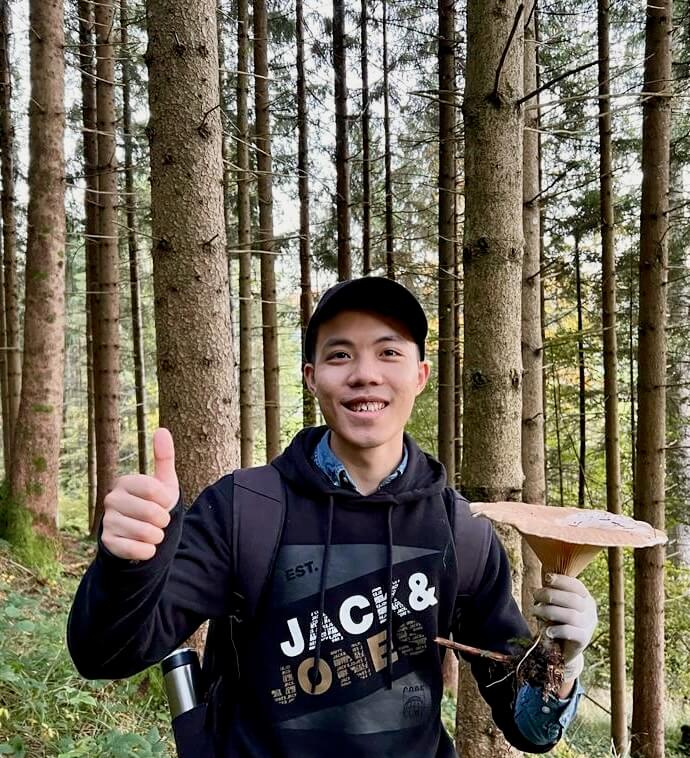
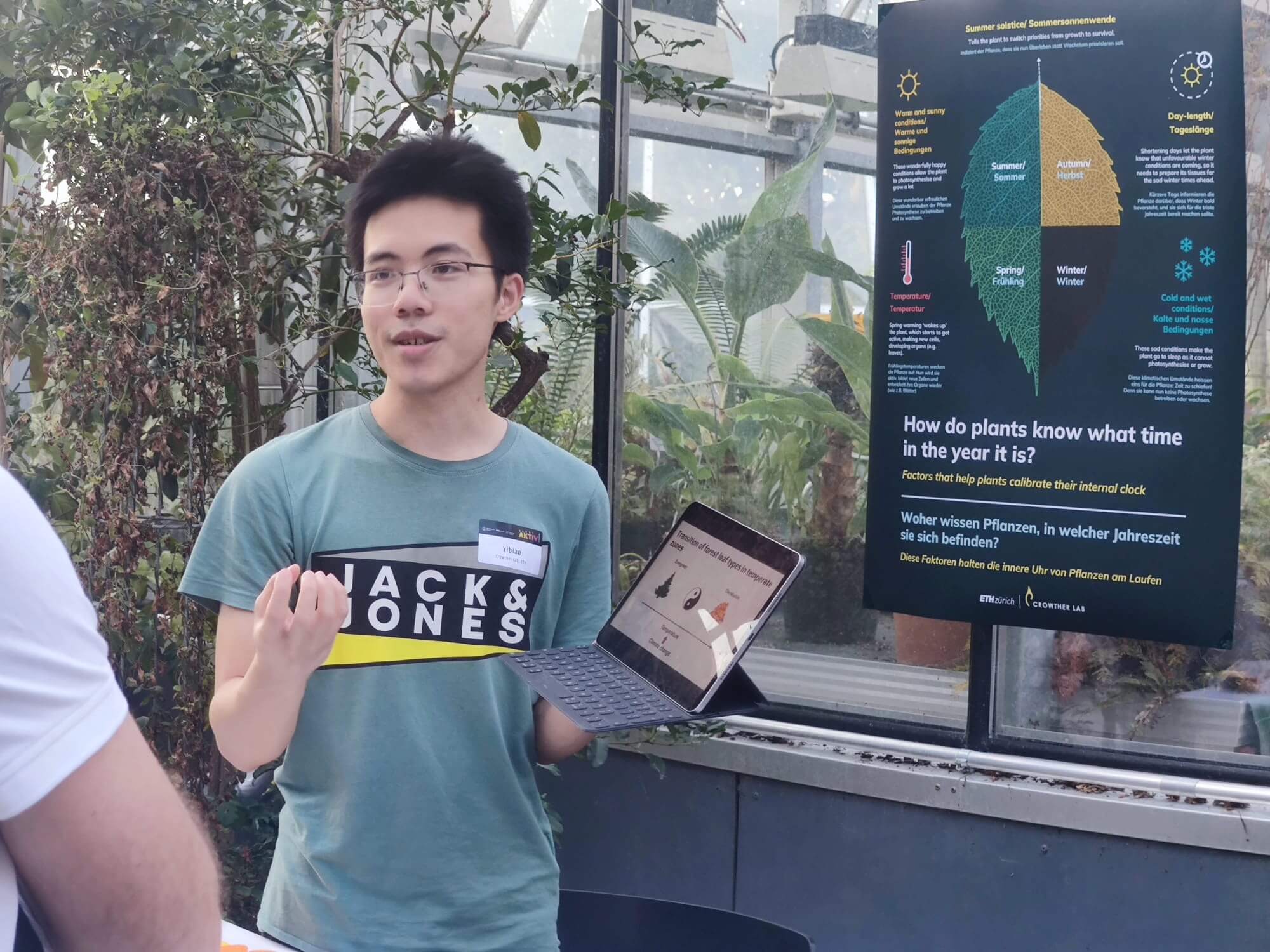
On June 10th, Yibiao Zou will defend his PhD at ETH Zürich. It is the culmination of five years of work built around the question: does it matter how forest is arranged, not just how much of it there is?
The answer, it turns out, is yes. And the implications reach all the way into how governments and corporations account for carbon when they make pledges about forests.
From tigers to tipping points
The absence that first shaped Yibiao’s thinking wasn’t something he saw. It was something already gone. South China tigers had disappeared from the wild decades before he was born, lost to habitat loss, fragmentation, and hunting. By the time he was growing up, they existed only in zoos. But what stayed with him was what happened after: without the predator, wild pig populations exploded and began invading cropland, creating real problems for local communities. “Even as a child, I had a very direct sense that destroying and fragmenting forests can reshape ecosystems in ways that affect both nature and people,” he says.
Yibiao grew up visiting a national forest park near his hometown in China, where his parents would take him to observe insects, catch fish, and watch birds. The tigers were gone, but the curiosity they sparked wasn’t. His childhood dream was to become an animal biologist.
That changed during his undergraduate studies in biology at Nanjing University. He read Theoretical Ecology by Robert May, a book that opened up a more mathematical, systems-level way of thinking about the natural world. “I kind of shifted from animal behavioural biology towards this more theoretical, data-driven and simulation-driven ecology,” he says. The pivot would define everything that followed.
He learned about Crowther Lab not through a conference or a paper, but through a friend’s WeChat posts. His undergraduate peer Haozhi Ma had arrived at ETH first, and Yibiao saw enough in those posts to reach out. He applied for a master’s degree, received an ETH scholarship, and emailed Tom Crowther early enough in the process to choose his supervisor before the program had even begun. Tom said yes, and Yibiao came to Zürich.
Five years of work – the research thread
Looking back across Yibiao’s publications, a clear arc emerges. His earlier work examined the global distribution of forest types and the feedbacks that keep them stable, asking what determines whether a landscape becomes one kind of forest or another, and whether those states can shift. From there, he turned to fragmentation itself: in a 2025 paper in Science, he and his collaborators, including Thomas W. Crowther, Gabriel Reuben Smith, Haozhi Ma, Lidong Mo, Lalasia Bialic-Murphy, Peter Potapov, Klementyna A. Gawecka, Chi Xu, and Constantin M. Zohner, showed that fragmentation had increased in over half of global forests between 2000 and 2020. They also found that protected areas showed significantly less fragmentation. This was evidence, Yibiao says, “that conservation can make a real difference.”
The new paper in Nature Ecology & Evolution is the logical next step. Having shown that fragmentation is increasing, Yibiao asked what it actually costs, not in terms of trees lost, but in terms of what the remaining forest can do. The answer: a hectare embedded within a large, connected forest is on average 38% more productive than an isolated hectare under otherwise identical conditions. Across the US as a whole, existing fragmentation has already reduced annual forest carbon uptake by 14%.
“A hectare of forest is not always equal to another hectare of forest,” he says. “If we want forests to keep absorbing carbon and helping us slow down climate change, we should care not only about how much forest remains, but also about how intact and connected it is.”
Completing a PhD During Periods of Upheaval
Yibiao describes the PhD as “a mix of excitement, stress, curiosity, and gratitude.” There were moments of real joy, like when a result suddenly made sense, when a paper came together, or simply time spent with colleagues and friends. But there were also long stretches of uncertainty, and the frustration that comes with rejections and setbacks.
What got him through the upheaval at Crowther Lab was, above all, the people around him. Colleagues, supervisors, and his current official supervisor Niklaus Zimmermann at WSL all helped ensure the transition didn’t derail his work.
But on a personal level, what anchored him was simpler: he kept going.
“During uncertain times, continuing to work — even in small steps — gave me something solid to hold on to,” he says. “I could not control the broader changes around me, but I could keep moving forward in my own work.”
Constantin Zohner, Yibiao’s PhD supervisor, describes Yibiao’s work. “The Nature Ecology & Evolution paper is a perfect example of Yibiao’s unique skillset, taking an important question and pursuing it at a scale that changes how we think about forest conservation. He listens deeply, thinks independently, and is exactly the kind of scientist who makes the whole field better.”
Who Yibiao is outside the lab
When he’s not working, Yibiao plays badminton two or three times a week. He met his girlfriend through a badminton club during his undergraduate years. He’s also ranked in the top 50 for several champions in Europe in League of Legends Wild Rift, out of around five million players. He also enjoys watching anime.
Asked what animal he’d want to be, he doesn’t hesitate: a panda. “A panda basically eats some bamboo and plays around with other pandas,” he says. “Sounds like a pretty nice life.”
What comes next
Yibiao will defend his PhD on June 10th in Zürich.